

Does cutting down on sugar help to treat yeast infections?

About 50 – 80% of all healthy persons have this yeast in their mouth and digestive system. If stool is found to contain large amount of this yeast, then you have a “candida infection”. This is believed to disturb normal intestinal processing of water, sugar and natrium and cause diarrhea.

Dental treatment under general anaesthesia

Some people are terrified of going to the dentist. Can they get help?
What used to be the exception years ago has now become a common procedure – dental treatment under general anaesthesia.
We’ve found out that one dental team in Austria goes even further and offers such patients not only treatment under anaesthesia, but also help [...]

Jaw pain – what now?

It has been found that the jaw is perfectly capable of adapting to a new set of teeth, this just takes some time. So nowadays doctors like to wait before starting any treatment. Only one device has been found to help in the acute phase of jaw pain – the Michigan rail.

Can teeth grow back?

Researchers speculate that if the trigger for tooth growth is found then one day teeth might be stimulated to grow back in adults. Although mammals only possess one set of teeth, some vertebrates have several sets of teeth that grow!

Dentists and hygiene

Have you ever found yourself sitting in the chair at the dentist and asking yourself who had those instruments in their mouth before you? Have they been properly disinfected and sterilized?

Inflammation of the dental nerve

Posted by Dental News Team am 01, Feb - 2010

endodontology

Dental nerve pain is usually a very bad sign, as it means the tooth requires root treatment!
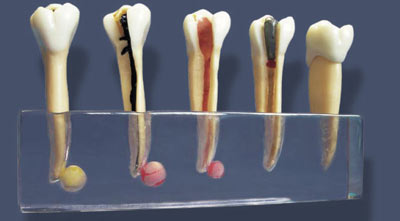
An initial sign of this kind of inflammation of the dental nerve (=pulpitis) is often a sensitivity towards cold and heat, eventually leading to a constant throbbing toothache.
The tooth is sensitive to the slightest touch. After a few days, these problems usually go away, and you no longer feel any pain! But this is actually a sure sign that the dental nerve should be removed and proper root canal treatment performed, since the nerve is now dead.
-
The damaged tissue begins to decay – it rots and even years later it can cause an inflammation at the root tip in the bone, necessitating a root tip resection. During root canal treatment the dentist extracts the dental nerve and cleanses the dental canal in order to then seal it up tightly!
Earlier, it was common practice to open up the affected tooth and inject a toxin into the dental nerve canal in order to kill off the nerve. Tomorrow you will find out why this used to be done and why it is not done anymore!


VN:F [1.8.1_1037]
Rating: 0.0/5 (0 votes cast)
VN:F [1.8.1_1037]
Rating: 0 (from 0 votes)

Popularity: 11% [?]

Leave a Reply