Archive for the ‘oral surgery’ Category

Getting your wisdom teeth out

Posted by admin On March - 12 - 2010

Should you get your wisdom teeth removed or shouldn’t you? Ask 3 different dentists – and you’ll get 4 different opinions!

Why are there so many different opinions when it comes to removing wisdom teeth?

This is mostly due to the fact that very few dentists actually perform this type of procedure themselves! Only oral surgeons or face, mouth and jaw surgeons are qualified and trained to remove wisdom teeth.

But most dentists are unwilling to send their patients to other dentists for fear they may end up “losing” them, so they wait as long as they can until one day problems arise – or not.

-

After wisdom tooth surgery, swelling remains for up to 3 days, then it goes down!
-

Here are some of the signs that the time has come to remove a wisdom tooth.
-

Here you can read a report on wisdom teeth transplants!
-

Best of luck – and stay cool!

VN:F [1.9.3_1094]
Rating: 0.0/5 (0 votes cast)
VN:F [1.9.3_1094]
Rating: 0 (from 0 votes)

Popularity: 9% [?]


oral surgery

Good dentist, bad dentist

Posted by Dental News Team On February - 22 - 2010

Wouldn’t you like to know whether your dentist is good or bad?

We assume you do, which is why this week we are going to tell you all about what to consider when looking for a dentist and how to find a good one.

As usual, we will provide you with an overview of this week’s main topic!

  1. Good dentist – the cost estimate
  2. Dentists and their teams
  3. Hygiene in the dentist’s office
  4. Explaining procedures
  5. Trouble-shooting

Good dentist – the cost estimate
First of all, does your dentist even bother giving you a cost estimate?
No? Then s/he has no idea what s/he is doing!

If yes, how is the estimate structures?
Did you get a thorough check-up before you got the estimate? You should know what has to be done in your case and what will only be performed to fill the dentist’s pockets. What are we going on about? Well, in order for the dentist to provide you with a good cost estimate, s/he needs to have a good idea of the current status of your teeth and mouth.

If s/he does not bother performing a check-up, then it is likely s/he will only do things that cost a lot, namely implants and crowns.

You can always tell good estimates from bad ones, because good estimates always provide detailed information, which is collected during a check-up (assuming, of course, that your mouth really needs an overhaul, not just one bridge or implant if your teeth and mouth are otherwise healthy, otherwise, what would be the point of collecting data!).

A good cost estimate includes:

  • An anamnesis (medical history) / Patient’s request
  • Findings
  • Diagnosis
  • Recommendations for therapy / Alternatives
  • Description of procedures as needed

This information lets the dentist know what you wish to be done, the condition of your teeth (periodontal status, photos, models of your teeth, …), anything and everything you’ll need to set up a treatment plan.
-

The cost estimate should consider all kinds of work, even work which is less lucrative to the dentist. This includes fillings, root canal treatment, operations such as removing wisdom teeth, etc.

-

But this is the kind of work which should usually be done first, before doing more complicated procedures – you should make sure the ground is in good shape before you start building houses on it (crowns, implants etc.).

-

Summing up, a simple cost estimate can and should tell you quite a lot!

  • If your dentist offers you any treatment without performing a thorough check-up first, then chances are that s/he is only going to do things which cost the most money!
  • If the cost estimate starts out with an extensive check-up, then you’re on the right path!
  • If a cost estimate begins with the least expensive types of treatment (renewed root treatment, removing wisdom teeth, periodontal work, …) with dentures (crowns, bridges) last on the list, then stick with that dentist!

More on this topic tomorrow, and by the end of the week you should be able to tell a good dentist from all others!

VN:F [1.9.3_1094]
Rating: 0.0/5 (0 votes cast)
VN:F [1.9.3_1094]
Rating: 0 (from 0 votes)

Popularity: 20% [?]


cosmetic-dentistry endodontology general topics implantology oral surgery orthodontics periodontology prostethics

Tongue cancer pictures

Posted by Dental News Team On January - 27 - 2010

What can you do to prevent tongue cancer?

There are a few rules to observe, such as avoiding

  • cigarettes
  • alcohol
  • spicy foods
  • licking or chewing on pencil lead or similar materials

Practice proper oral hygiene and get regular dental cleaning, and if you should ever sense something funny in your mouth, then wait a week and if it’s still there, go see a doctor! If you belong to a high-risk group (such as nicotine addicts) then get regular check-ups!

VN:F [1.9.3_1094]
Rating: 0.0/5 (0 votes cast)
VN:F [1.9.3_1094]
Rating: 0 (from 0 votes)

Popularity: 37% [?]


general topics oral surgery

Symptoms of tongue cancer

Posted by Dental News Team On January - 26 - 2010

Symptoms of tongue cancer

You have a sore spot on your tongue which just refuses to heal – you suspect it may be tongue cancer – what now?
Generally, whenever you have a sore or some alteration in the mucuous membrane of your mouth, you should remove your denture (assuming you have one), stop taking medication (even homeopathic medication) and wait a week.
-
Should the sore refuse to heal even after a full week, then you need to go to the hospital and get a biopsy.
-
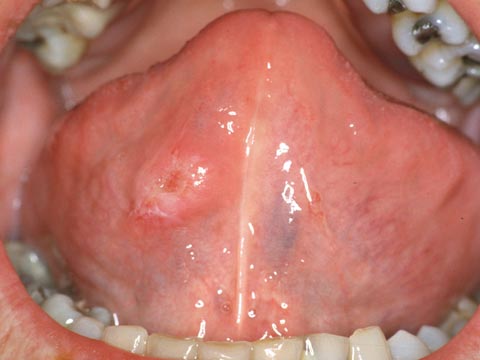
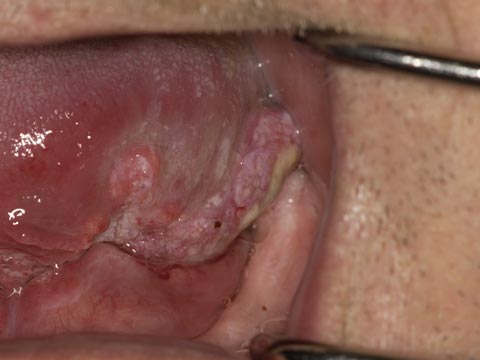
Now you can see some pictures showing tongue cancer in its early stages, but these pictures are by no means exhaustive! You will see more pictures tomorrow, and find out how you can avoid tongue cancer and oral cancer!

-


-

-

-

-

-

VN:F [1.9.3_1094]
Rating: 0.0/5 (0 votes cast)
VN:F [1.9.3_1094]
Rating: 0 (from 0 votes)

Popularity: 30% [?]


general topics oral surgery
general topics, oral surgery

When is the right time to pull a tooth?

Posted by Dental News Team On January - 25 - 2010

How long should you bother keeping a tooth?

Get a tooth removed, or wait, but for how long? As long as you still have good reason to!

We are talking about severely damaged teeth, teeth that have undergone root treatment but are still causing problems. The picture shows you a tooth that there is no more reason to keep.
The patient underwent root treatment 4 years previously and is still experiencing pain in this area. Root tip resection was performed, but to no avail. During the root tip resection, the tooth received neither an orthograde nor a retrograde filling – more on this topic here

-
The patient opted for another resection, but in the course of the operation it became evident that the tooth needed extraction.

-

The mucous membrane has been flipped to the side, you can see a small window of bone (highlighted in white), and you can clearly see the tooth (highlighted in black) – the root tip has already been cut. The inside of the tooth is highlighted in blue, inside the pink dot you can see the filling compound. Around the compound, however, the tooth has started to rot  – the black area. There is no more point in keeping this tooth, as faulty root treatment has caused the tooth to rot from the inside. Another root tip resection may help to put off the problem for a while, but not eliminate it completely!

VN:F [1.9.3_1094]
Rating: 0.0/5 (0 votes cast)
VN:F [1.9.3_1094]
Rating: 0 (from 0 votes)

Popularity: 14% [?]


oral surgery
oral surgery